

How To Draw A Flowchart With Ggplot In R
The diagram package makes it easy to create flowcharts in R. In this post I'll bear witness an case of creating a uncomplicated flowchart. The most important part is to understand how the coordinate systems works; one time you understand that, it'southward just a affair of placing your arrows and boxes accordingly to create your flowchart. To get started, install the package if you oasis't already.
install.packages('diagram') The flowchart I want to create has 13 steps and I want the boxes arranged in the formation 1, 3, 3, 3, and 3. Imagine a football/soccer germination with 1 person at the tiptop, followed by iii, and some other 3 and so on. The coordinates() role helps me create this.
library(diagram) # creates an empty plot openplotmat() # create the coordinates pos <- coordinates(c(ane,3,3,three,3)) pos [,i] [,2] [1,] 0.5000000 0.ix [2,] 0.1666667 0.7 [3,] 0.5000000 0.7 [4,] 0.8333333 0.7 [5,] 0.1666667 0.five [half dozen,] 0.5000000 0.5 [7,] 0.8333333 0.v [8,] 0.1666667 0.3 [9,] 0.5000000 0.three [10,] 0.8333333 0.three [eleven,] 0.1666667 0.1 [12,] 0.5000000 0.i [13,] 0.8333333 0.1 class(pos) [1] "matrix" plot(pos, blazon = 'northward') text(pos)

The coordinate organisation ranges from 0 to 1 on both the x and y axes. The coordinates stored in the matrix pos are used to specify connections for arrows and to identify boxes. The order in which you draw the objects matters; if you place the boxes starting time, the arrows volition be placed on acme of the boxes.
I will use two types of arrows: straightarrow() and segmentarrow(). They are straightforward to employ; you merely need to specify the starting time and terminate points. The segmentarrow() requires a fiddling bit of tinkering for aesthetic purposes.
par(mar = rep(1, iv)) openplotmat() pos <- coordinates(c(i,3,3,3,3)) # the dd parameter was used to move the segment arm segmentarrow (from = pos[1, ], to = pos[2, ], dd = 0.45) straightarrow(from = pos[2, ], to = pos[three, ]) straightarrow(from = pos[three, ], to = pos[4, ]) straightarrow(from = pos[vii, ], to = pos[six, ]) straightarrow(from = pos[6, ], to = pos[5, ]) straightarrow(from = pos[ten, ], to = pos[ix, ]) straightarrow(from = pos[9, ], to = pos[eight, ]) straightarrow(from = pos[13, ], to = pos[12, ]) straightarrow(from = pos[12, ], to = pos[xi, ]) # the path parameter was used to change the direction # arr.pos was used to position the arrow # arr.side was used to specific where the pointer should be drawn segmentarrow (from = pos[4, ], to = pos[7, ], dd = 0.fifteen, path = 'RVL', arr.pos = 0.24, arr.side = 3) segmentarrow (from = pos[4, ], to = pos[10, ], dd = 0.xv, path = 'RVL', arr.pos = 0.24, arr.side = 3) segmentarrow (from = pos[iv, ], to = pos[xiii, ], dd = 0.fifteen, path = 'RVL', arr.pos = 0.24, arr.side = 3)

At present nosotros can depict the boxes on top of the arrows. I've added some conditionals just to change the colour of the boxes.
my_label <- c(1, ii, 3, 4, 7, 6, 5, ten, 9, 8, 13, 12, 11) my_text_size <- 1.3 my_edge_length <- 0.08 for(i in 1:length(my_label)){ if (i %in% 5:7){ textrect(mid = pos[i,], radx = my_edge_length, rady = my_edge_length, lab = my_label[i], cex = my_text_size, box.col = "#0072B2") } else if (i %in% 8:10){ textrect(mid = pos[i,], radx = my_edge_length, rady = my_edge_length, lab = my_label[i], cex = my_text_size, box.col = "#009E73") } else if (i %in% eleven:thirteen){ textrect(mid = pos[i,], radx = my_edge_length, rady = my_edge_length, lab = my_label[i], cex = my_text_size, box.col = "#D55E00") } else { textrect(mid = pos[i,], radx = my_edge_length, rady = my_edge_length, lab = my_label[i], cex = my_text_size, box.col = "#999999") } } 
Functions for flowcharts
In the instance to a higher place I only used two types of arrows and one type of textbox. Below is a full list of the arrows and textboxes that can be used for creating flowcharts.
| Part | Description |
|---|---|
| openplotmat | creates an empty plot |
| coordinates | calculates coordinates of elements, neatly bundled in rows/columns |
| bentarrow | adds 2-segmented arrow betwixt two points |
| curvedarrow | adds curved arrow between two points |
| segmentarrow | adds 3-segmented pointer between 2 points |
| selfarrow | adds a circular self-pointing pointer |
| splitarrow | adds a branched arrow between several points |
| straightarrow | adds direct arrow between 2 points |
| treearrow | adds dendrogram-like branched arrow between several points |
| shadowbox | adds a box with a shadow to a plot |
| textdiamond | adds lines of text in a diamond-shaped box to a plot |
| textellipse | adds lines of text in a ellipse-shaped box to a plot |
| textempty | adds lines of text on a colored background to a plot |
| texthexa | adds lines of text in a hexagonal box to a plot |
| textmulti | adds lines of text in a multigonal box to a plot |
| textparallel | adds lines of text in a parallelogram to a plot |
| textplain | adds lines of text to a plot |
| textrect | adds lines of text in a rectangular-shaped box to a plot |
| textround | adds lines of text in a rounded box to a plot |
The vignette contains lawmaking to visualise all the different types of textboxes.
openplotmat(main = "textbox shapes") rx <- 0.1 ry <- 0.05 pos <- coordinates(c(ane, ane, 1, one, 1, 1, 1,1 ), mx = -0.2) pos textdiamond(mid = pos[1,], radx = rx, rady = ry, lab = LETTERS[i], cex = ii, shadow.col = "lightblue") textellipse(mid = pos[2,], radx = rx, rady = ry, lab = Messages[ii], cex = 2, shadow.col = "blue") texthexa(mid = pos[3,], radx = rx, rady = ry, lab = Messages[3], cex = 2, shadow.col = "darkblue") textmulti(mid = pos[4,], nr = 7, radx = rx, rady = ry, lab = Messages[4], cex = 2, shadow.col = "red") textrect(mid = pos[v,], radx = rx, rady = ry, lab = LETTERS[v], cex = 2, shadow.col = "darkred") textround(mid = pos[6,], radx = rx, rady = ry, lab = LETTERS[6], cex = 2, shadow.col = "black") textparallel(mid = pos[7,], radx = rx, rady = ry, lab = Messages[7], cex = 2, theta = twoscore, shadow.col = "black") textempty(mid = pos[eight,], lab = LETTERS[8], cex = 2, box.col = "yellow") pos[ ,i] <- pos[ ,1] + 0.5 pos text(pos[ ,ane],pos[ ,2], c("textdiamond", "textellipse", "texthexa", "textmulti", "textrect", "textround", "textparallel", "textempty")) 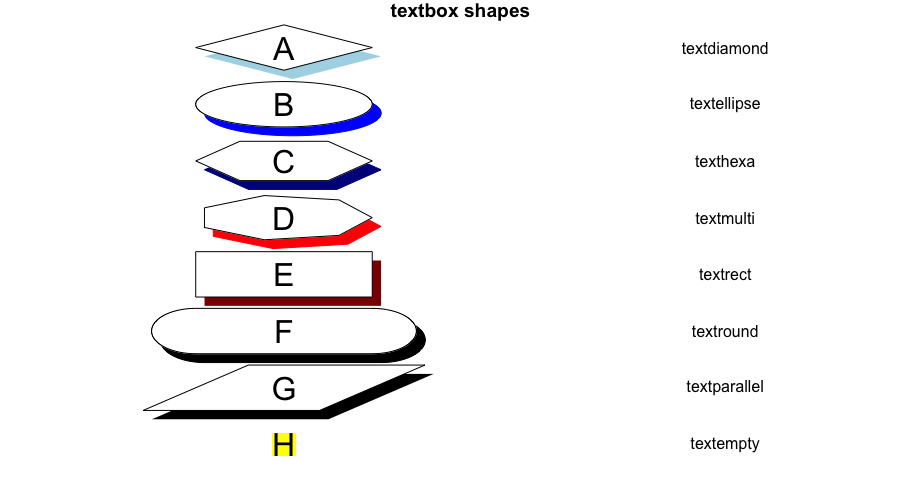
And all the different arrows.
par(mar = c(1, ane, one, 1)) openplotmat(master = "Arrowtypes") elpos <- coordinates (c(1, ii, 1), mx = 0.1, my = -0.ane) curvedarrow(from = elpos[i, ], to = elpos[2, ], bend = -0.5, lty = two, lcol = 2) straightarrow(from = elpos[1, ], to = elpos[2, ], lty = 3, lcol = 3) segmentarrow (from = elpos[1, ], to = elpos[2, ], lty = 1, lcol = 1) treearrow (from = elpos[2:3, ], to = elpos[iv, ], lty = 4, lcol = four) bentarrow (from = elpos[3, ], to = elpos[3, ]-c(0.1, 0.1),arr.pos=1,lty=5,lcol=5) bentarrow(from = elpos[1, ], to = elpos[three, ], lty = 5, lcol = five) selfarrow(pos = elpos[3, ], path = "R",lty = 6, curve = 0.075, lcol = half-dozen) splitarrow(from = elpos[1, ], to = elpos[2:iii, ], lty = 1, lwd = 1, dd = 0.7, arr.side = 1:ii, lcol = 7) for ( i in i:four){ textrect (elpos[i, ], 0.05, 0.05, lab = i, cex = i.5) } legend("topright", lty = ane:7, legend = c("segmentarrow","curvedarrow", "straightarrow", "treearrow", "bentarrow", "selfarrow", "splitarrow"), lwd = c(rep(2, 6), 1), col = i:7) 
Summary
I thought the diagram bundle was quite like shooting fish in a barrel to use for creating a flowchart in R. I needed to tinker a fleck with the placement of lines and arrows but all in all it didn't accept long to create the flowchart.


Source: https://davetang.org/muse/2017/03/31/creating-flowchart-using-r/
Posted by: garciadionly1958.blogspot.com
0 Response to "How To Draw A Flowchart With Ggplot In R"
Post a Comment