

How Much Draw Weight Does An Olympic Archer Draw
Bullseye —
What is all that stuff? A closer look at an Olympic-quality bow
A contest-course bow has it all, from high-tech materials to uncomplicated mechanics.
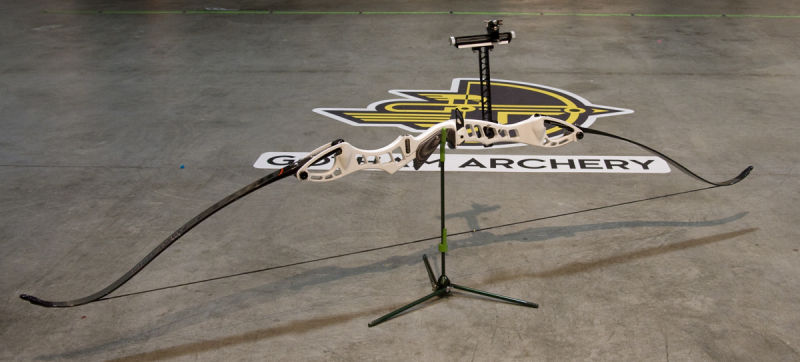
Enlarge / A recurve bow, showing the recurved limbs and the primal riser.
John Timmer
A lot of us have simply seen archery on episodes of Game of Thrones, or maybe we have hazy memories of a uncomplicated fiberglass bow at summer campsite. If that's your flick of archery technology, so a modern bow probably looks like it was dropped off by aliens.
To discover out how this equipment really functions, we took a subway ride to Gotham Archery, where Anjalie Field walked u.s. through all the moving (and, hopefully, stationary) parts of a bow that's fit for competitive archery. Field got hooked on the sport while young, and she loved it so much that when she ended up at a college without an archery team, she founded one.
Field explained that there are two classes of bows, compound bows and recurves. The string on a chemical compound bow is threaded through a series of pulleys. These pulleys rotate off-center equally the string is drawn back, changing the forces involved. Typically, this ways that the initial describe requires considerable force, but once information technology'southward fully drawn, less effort is involved in holding it there.
While in that location are international competitions for compound bows, Olympic competitions apply what are called recurves , named "recurves" because when the bow isn't drawn, the ends of the bow curve back in the direction the arrow volition travel. This enhances the amount of force transferred to the arrow, at the price of adding to the strain of getting and keeping the bow drawn. Unlike chemical compound bows, recurve bows need a steadily increasing amount of force in order for the archer to pull back on the bow string.
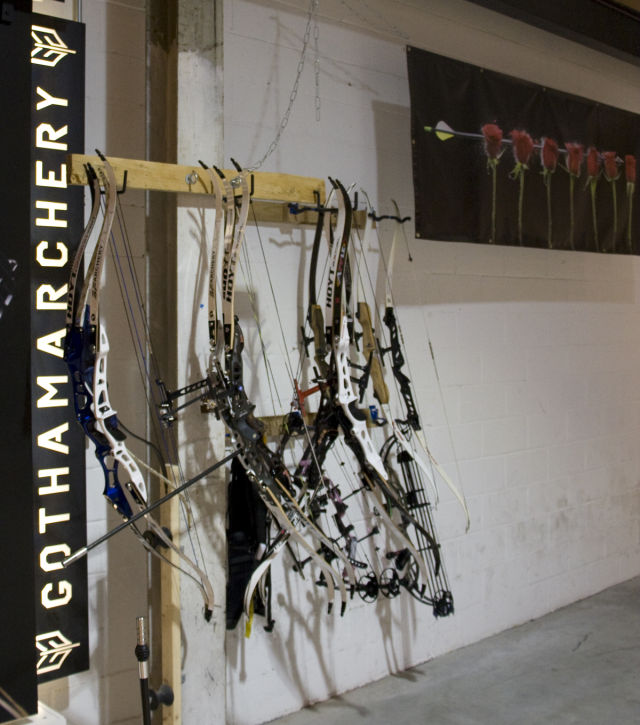
Enlarge / Some of the hardware on display at Brooklyn'due south Gotham Archery.
John Timmer
Bows used in the Olympics take three main parts: ii limbs and a central piece called a riser. The riser doesn't bend and is typically made of machined metal (usually aluminum) in a honeycomb structure with plenty of open space. This design cuts downward on weight, although weight does add to stability while aiming. The structure is also made to dampen vibrations that would otherwise occur when the cord is released.
The limbs are typically made of a fiberglass-carbon fiber composite. This composition allows manufacturers to fine-tune the limbs and then that they require different amounts of force to flex back (the forcefulness needed for a full draw is called "depict weight"). To some extent, draw weight goes upwards with the length of the limbs. Limbs have to match the arm length of the archer so that a full describe places the end of the arrow near the face for aiming. But, because the limbs can exist tailored to different depict weights, it's possible to create limbs for a long-armed user that don't require a crippling corporeality of force to pull back (something I verified during my trip to Gotham Archery).
Since they're not used in gainsay, Olympic-way recurve bows no longer need to send arrows off with plenty forcefulness to punch through anything. And, for indoor use, where targets are typically eighteen meters away, a draw weight of 30 lbs is oft fine. But outdoor competitions are typically at 70 meters, and then more force is needed to ensure the pointer gets to the target. Plus, the more quickly the arrows travel, the less chance there is for wind gusts or other factors to throw things off. So Field said many archers use bows with describe weights of over twoscore lbs.
Beyond the trunk of the bow, archers rely on a lot of additional pieces of equipment, both obvious and not. The most obvious ones are stabilizers, a set up of long rods that are typically ready in a triangular configuration, extending out from the body of the bow. A stabilizer is just one of a number of devices that compensates for a ofttimes disregarded fact: one time the string is released, the pointer remains in contact with the bow for a fraction of a 2nd, and it can exist thrown off course by things that happen during that time.
"The main matter [stabilizers] do is to absorb vibrations," Field told Ars. "So normally they'll have a petty condom damper on the end that helps reduce shock, so when yous permit get, the bow doesn't vibrate every bit much." Stabilizers likewise help resist torque caused past the release. Finally, the extra weight helps steady the bow while aiming.
At that place's also a pocket-size plunger set next to the hardware where the arrow rests on the bow prior to release. This plunger absorbs some of the shock in the arrow caused by the release, which is what typically sets the arrow vibrating. The residue itself slides out of the way with a minimum of strength as the arrow goes past. Arrows are also constructed and so that the vibrations they take with them are dampened gradually during flying, while the fletching is curved to cause arrows to rotate as they travel.
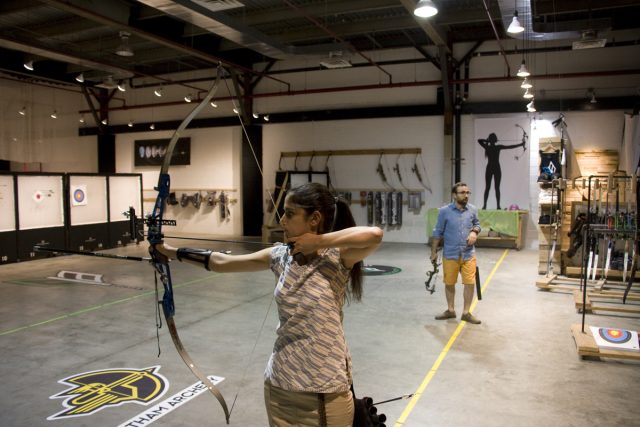
Enlarge / Our tour guide, Anjalie Field, gets ready to let loose. Notation the stabilizers extending out from her bow's riser (one is backside her arm).
Another obvious attachment is the sight, which helps the archer direct the shot. In one case sights are attached to the bow, threaded screws permit fine-scale adjustments. "Information technology'due south mostly gauge and bank check," Field said, with archers tweaking the sight in response to where their arrows end up. The simply real question, she said, is whether an issue is best handled by adjusting the sight or adjusting your form.
The last affair Field showed off was called a clicker. Information technology's a thin, spring-loaded metal wire that rests on summit of the arrow every bit information technology'due south drawn back. When the bow is fully drawn, the tip of the arrow slides from under the clicker, allowing the wire to drop, making an aural click. That, Field says, means it's fourth dimension to release.
While the materials may exist high-tech, most of the hardware is pretty elementary and serves an obvious purpose. "A lot of information technology is really designed to requite forgiveness," Field told Ars. "If you equally the human archer, if you do the exact aforementioned affair every time, in theory, your arrow should get to the verbal aforementioned place every time. The problem is that it's really hard to do the verbal same thing every time. So a lot of these fiddling devices are designed to give you lot a little forgiveness, and so if yous do something a little differently, it won't make that much of a difference in where your arrow goes."

Source: https://arstechnica.com/gadgets/2016/08/what-is-all-that-stuff-a-closer-look-at-an-olympic-quality-bow/
Posted by: garciadionly1958.blogspot.com
0 Response to "How Much Draw Weight Does An Olympic Archer Draw"
Post a Comment