

How To Draw Thor's Hammer
Chapter 1 Draw " Thor's Hammer. " 1. 1 Overview of Pro / Engineer System 1. 2 Working interface 1. 3 File operation 1. 4 View display control 1. 5 Draw " Thor's Hammer. "
1. 1 Overview of Pro / Engineer System Pro / Engineer software is an all-round 3 D product development software, which integrates the functions of part design, surface design, engineering drawing production, product assembly, mold development, NC machining, circuit design, metal plate design, modeling design, automatic measurement, mechanism simulation, stress analysis, finite element analysis and product data management.
1. 1. 1 Introduction to the Main Modules and Functions of Pro / E System 1. Sketch module: Create and edit 2 D plane sketches 2. Part: Creating 3 D Models 3. Assembly: Assembly of parts or complete products 4. Drawing: Generate 2 D drawing from 3 D model 5. Manufacturing: high-speed machining, specialized machining and mold design
1. 1. 2 System startup and shutdown 1. Start the Pro / E system ( 1 ) Start with Windows taskbar ( 2 ) Use shortcut to start ( 3 ) Start with [ Run ] command 2. Close the Pro / E system Two methods: Select [File] -> [Exit]; Click the [Close] button in the upper right corner of the work window
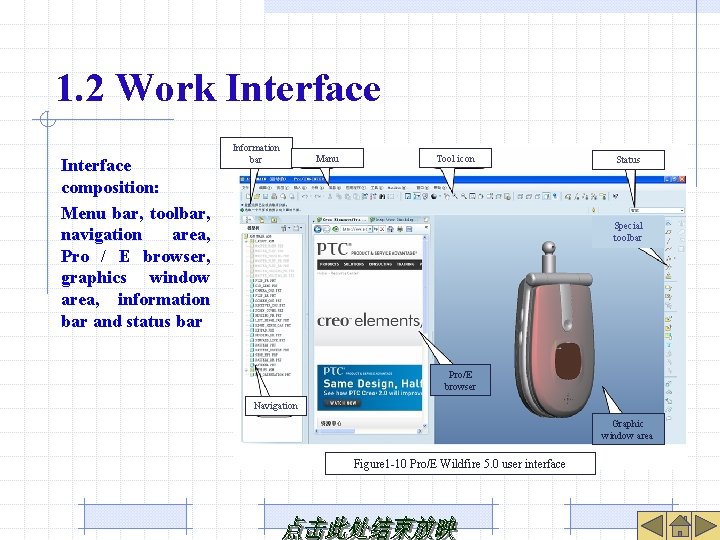
1. 2 Work Interface composition: Menu bar, toolbar, navigation area, Pro / E browser, graphics window area, information bar and status bar Information bar Manu Tool icon Status Special toolbar Pro/E browser Navigation Graphic window area Figure 1 -10 Pro/E Wildfire 5. 0 user interface
1. 2. 1 Menu bar Covers all basic operations and model processing functions of Pro / E. The menu bar commands of different modules are slightly different, taking the part module as an example. [ File ]: File operation and processing, such as new construction, opening, saving, printing, etc. [ Edit ]: Feature editing operations, such as feature reproduction, copying, deletion, array, etc. [ View ]: Manage the display attributes of the drawing area, set the display status of the model or control the size and orientation of the display of the model; [ Insert ]: Provides commands to create various features; [ Analysis ]: Measurement of the model, analysis of physical properties, curve and surface properties, etc. ; [ Info ]: Provides information on models, features, references, etc. ; [ Application ]: Including optional modules to expand the functions of the software system; [ Tools ]: Control Pro / E working environment, customized interface, setting relationship or parameters, etc. 【 Window 】: Operate a single main window and switch between multiple main windows. Help: Perform Pro / E's online help function.
1. 2. 2 Toolbar There are two main categories: icon toolbar ( lower part of menu bar ) and feature toolbar Toolbar customization: select the tools - > customize command to adjust the button position of the toolbar and the contents of the toolbar.
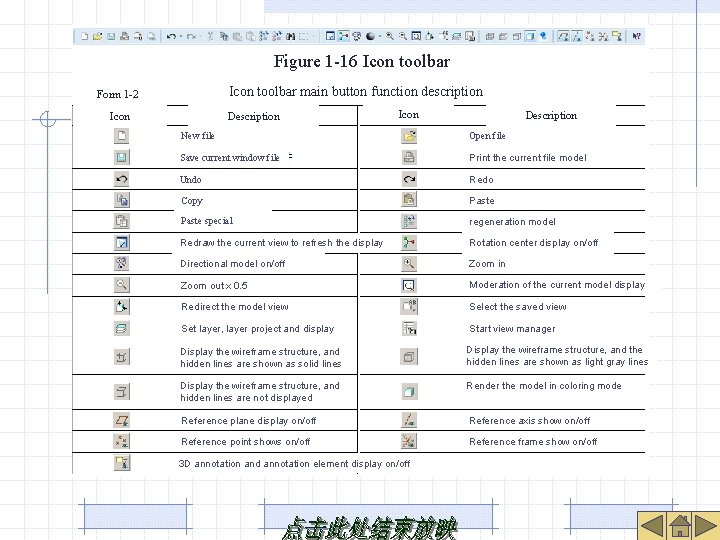
Figure 1 -16 Icon toolbar main button function description Form 1 -2 Icon Description New file Open file Save current window file Print the current file model Undo Redo Copy Paste special regeneration model Redraw the current view to refresh the display Rotation center display on/off Directional model on/off Zoom in Zoom out x 0. 5 Moderation of the current model display Redirect the model view Select the saved view Set layer, layer project and display Start view manager Display the wireframe structure, and hidden lines are shown as solid lines Display the wireframe structure, and the hidden lines are shown as light gray lines Display the wireframe structure, and hidden lines are not displayed Render the model in coloring mode Reference plane display on/off Reference axis show on/off Reference point shows on/off Reference frame show on/off 3 D annotation and annotation element display on/off
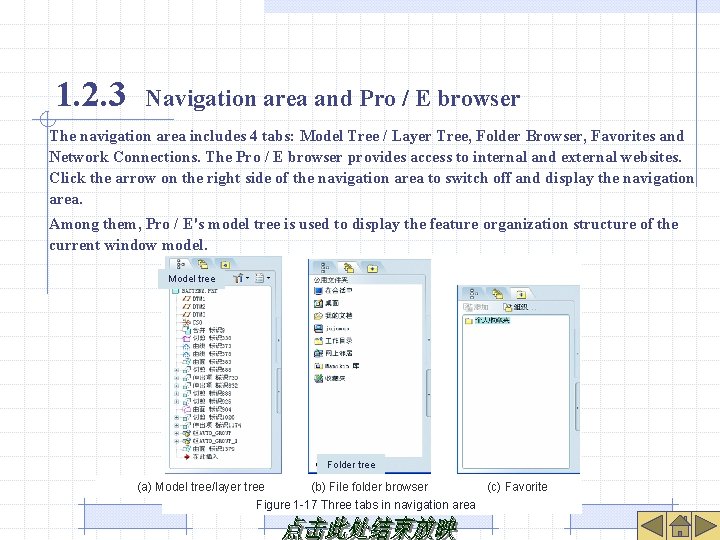
1. 2. 3 Navigation area and Pro / E browser The navigation area includes 4 tabs: Model Tree / Layer Tree, Folder Browser, Favorites and Network Connections. The Pro / E browser provides access to internal and external websites. Click the arrow on the right side of the navigation area to switch off and display the navigation area. Among them, Pro / E's model tree is used to display the feature organization structure of the current window model. Model tree Folder tree (a) Model tree/layer tree (b) File folder browser (c) Favorite Figure 1 -17 Three tabs in navigation area
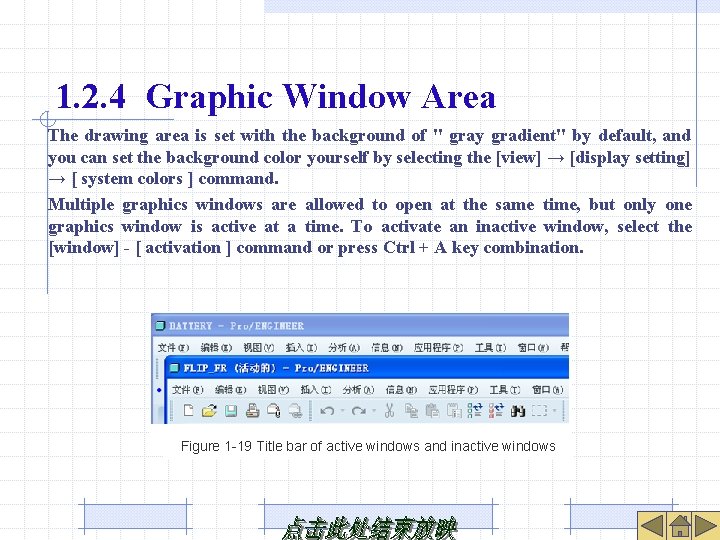
1. 2. 4 Graphic Window Area The drawing area is set with the background of " gray gradient" by default, and you can set the background color yourself by selecting the [view] → [display setting] → [ system colors ] command. Multiple graphics windows are allowed to open at the same time, but only one graphics window is active at a time. To activate an inactive window, select the [window] - [ activation ] command or press Ctrl + A key combination. Figure 1 -19 Title bar of active windows and inactive windows
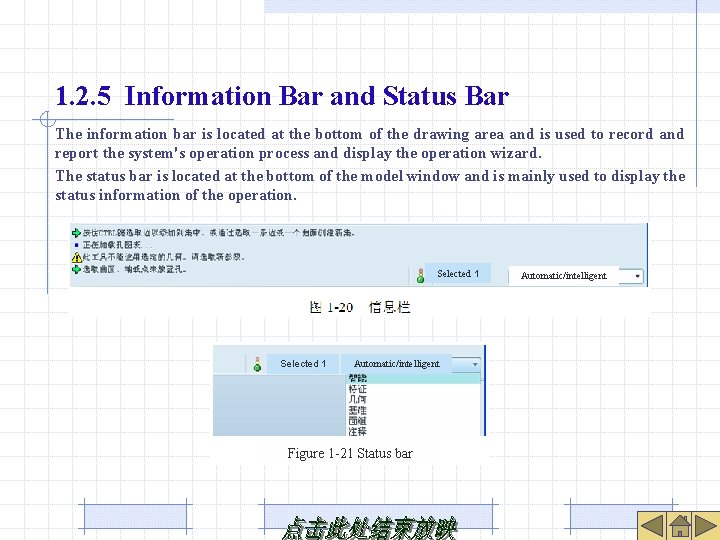
1. 2. 5 Information Bar and Status Bar The information bar is located at the bottom of the drawing area and is used to record and report the system's operation process and display the operation wizard. The status bar is located at the bottom of the model window and is mainly used to display the status information of the operation. Selected 1 Automatic/intelligent Figure 1 -21 Status bar Automatic/intelligent
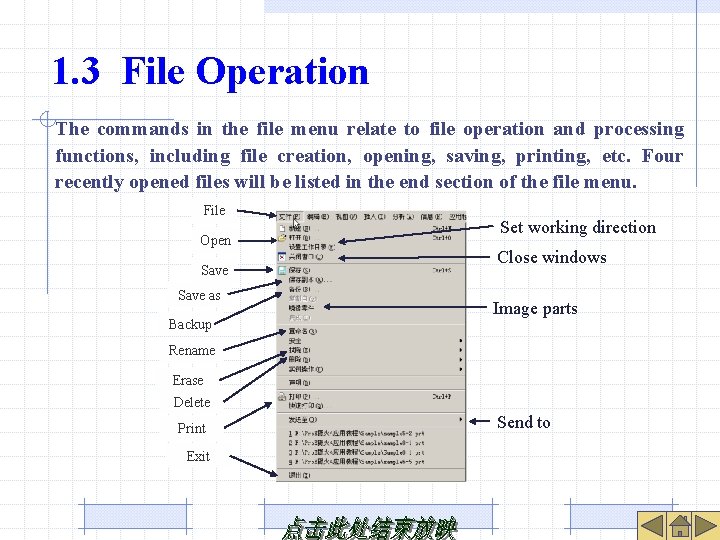
1. 3 File Operation The commands in the file menu relate to file operation and processing functions, including file creation, opening, saving, printing, etc. Four recently opened files will be listed in the end section of the file menu. File Open Save as Backup Set working direction Close windows Image parts Rename Erase Delete Print Exit Send to
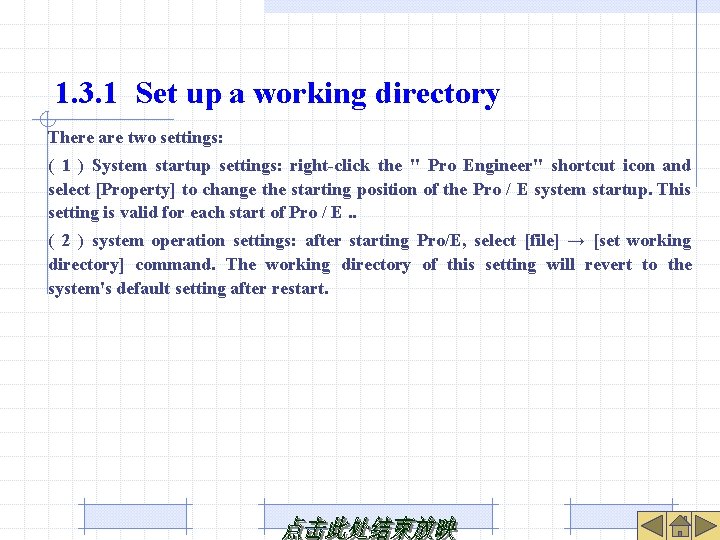
1. 3. 1 Set up a working directory There are two settings: ( 1 ) System startup settings: right-click the " Pro Engineer" shortcut icon and select [Property] to change the starting position of the Pro / E system startup. This setting is valid for each start of Pro / E. . ( 2 ) system operation settings: after starting Pro/E, select [file] → [set working directory] command. The working directory of this setting will revert to the system's default setting after restart.
![1. 3. 2 Newly Create File Select the [file] → [newly create] command or](https://slidetodoc.com/presentation_image_h/10023d3f3a8c5602f6deae20c7e68478/image-14.jpg "1. 3. 2 Newly Create File Select the [file] → [newly create] command or")
1. 3. 2 Newly Create File Select the [file] → [newly create] command or click the tool button. Form 1 -3 Description of file type and subtype Description Default folder name and extension 2 D drafting Solid part (Default) Part assembly (Default) Assembled parts processing (Default) Mold design 2 D drawing 2 D mechanical engineering drawing, layout and format Written statement Layout drawing of planar circuit and pipeline Product layout planning Annotation
![1. 3. 3 Open and Close Files Open File: Select [File] → [Open] or](https://slidetodoc.com/presentation_image_h/10023d3f3a8c5602f6deae20c7e68478/image-15.jpg "1. 3. 3 Open and Close Files Open File: Select [File] → [Open] or")
1. 3. 3 Open and Close Files Open File: Select [File] → [Open] or click the tool button. You can turn model preview on or off to quickly view the model of the specified file. If a file has multiple versions, the latest version is opened by default. Close file: select [file] → [close window] command or click the tool button. As long as you do not exit the Pro / E system, the model data of the closed file still resides in the system session process. Open Figure 1 -24 'Open File' dialog box Cancel
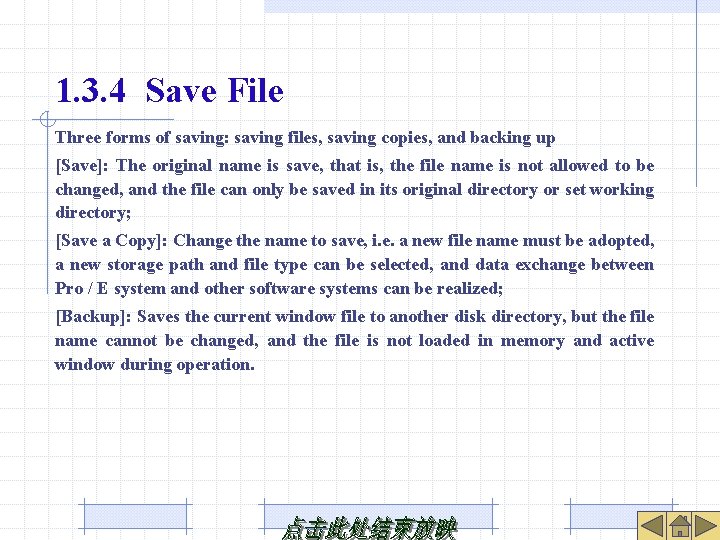
1. 3. 4 Save File Three forms of saving: saving files, saving copies, and backing up [Save]: The original name is save, that is, the file name is not allowed to be changed, and the file can only be saved in its original directory or set working directory; [Save a Copy]: Change the name to save, i. e. a new file name must be adopted, a new storage path and file type can be selected, and data exchange between Pro / E system and other software systems can be realized; [Backup]: Saves the current window file to another disk directory, but the file name cannot be changed, and the file is not loaded in memory and active window during operation.
![1. 3. 5 Erase and Delete Files [Erase]: Clear Pro / E model files](https://slidetodoc.com/presentation_image_h/10023d3f3a8c5602f6deae20c7e68478/image-17.jpg "1. 3. 5 Erase and Delete Files [Erase]: Clear Pro / E model files")
1. 3. 5 Erase and Delete Files [Erase]: Clear Pro / E model files residing in the session process, but do not delete files on disk. (1) [Current]: Clear the file of the current active window from the session process. (2) [Not Displayed]: Clear all files that reside in the session process (memory) but are not in the window from the session process. [Delete]: Permanently delete the specified Pro / E file from the disk. (1) Old Versions: Deletes all previous versions except the latest version from the specified file object. (2) [All Versions]: Delete all versions of the specified file object.
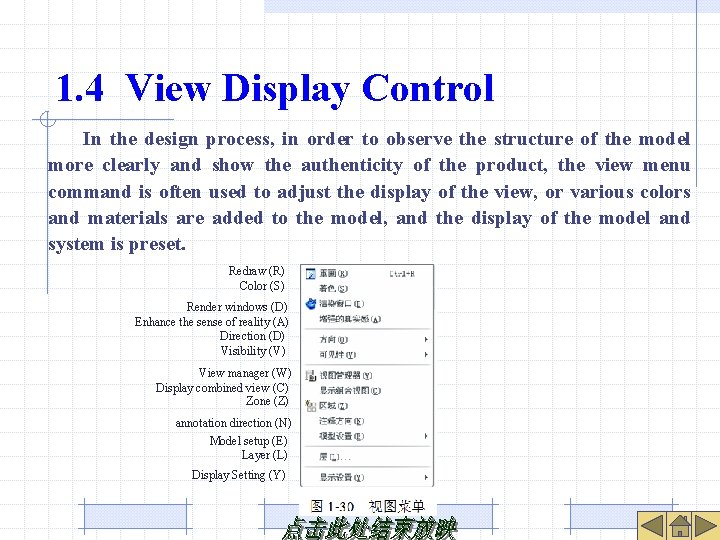
1. 4 View Display Control In the design process, in order to observe the structure of the model more clearly and show the authenticity of the product, the view menu command is often used to adjust the display of the view, or various colors and materials are added to the model, and the display of the model and system is preset. Redraw (R) Color (S) Render windows (D) Enhance the sense of reality (A) Direction (D) Visibility (V) View manager (W) Display combined view (C) Zone (Z) annotation direction (N) Model setup (E) Layer (L) Display Setting (Y)
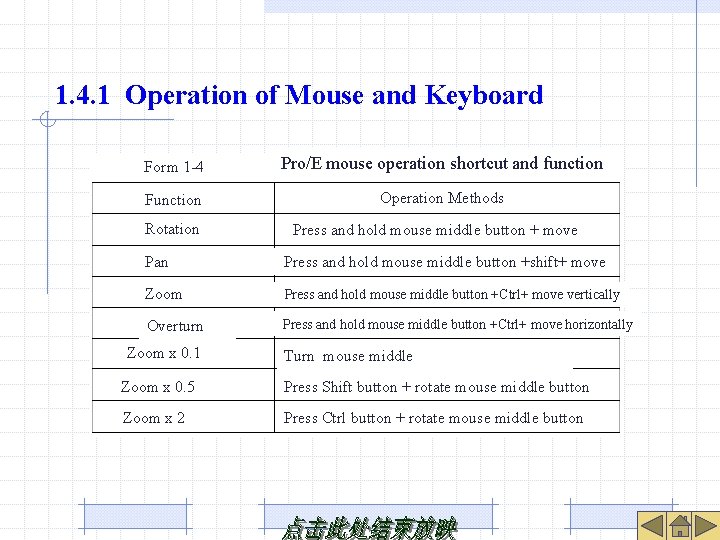
1. 4. 1 Operation of Mouse and Keyboard Form 1 -4 Pro/E mouse operation shortcut and function Function Operation Methods Rotation Press and hold mouse middle button + move Pan Press and hold mouse middle button +shift+ move Zoom Press and hold mouse middle button +Ctrl+ move vertically Overturn Press and hold mouse middle button +Ctrl+ move horizontally Zoom x 0. 1 Turn mouse middle Zoom x 0. 5 Press Shift button + rotate mouse middle button Zoom x 2 Press Ctrl button + rotate mouse middle button
![1. 4. 2 Model Color and Appearance 1. Setting of Appearance Color Select [View]](https://slidetodoc.com/presentation_image_h/10023d3f3a8c5602f6deae20c7e68478/image-20.jpg "1. 4. 2 Model Color and Appearance 1. Setting of Appearance Color Select [View]")
1. 4. 2 Model Color and Appearance 1. Setting of Appearance Color Select [View] → [Color and Appearance]. Appearance Editor Search… Pattern Basic Model Library More Appearance manager Figure 1 -38 Appearance Editor dialog box Figure 1 -39 Color properties setting
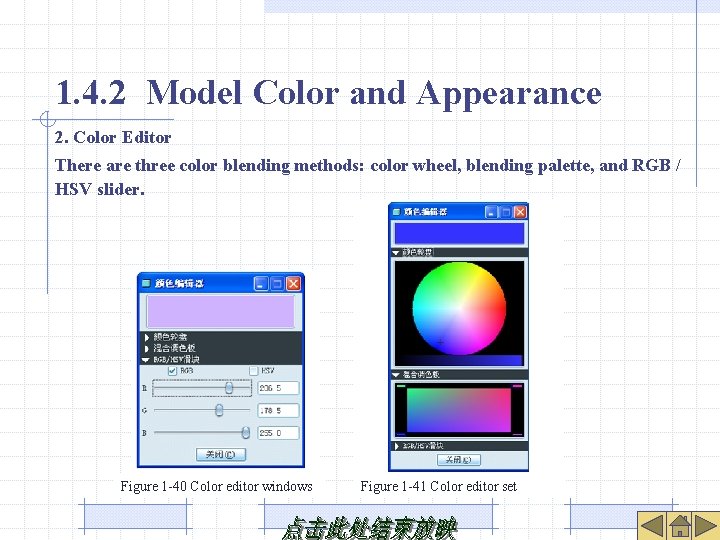
1. 4. 2 Model Color and Appearance 2. Color Editor There are three color blending methods: color wheel, blending palette, and RGB / HSV slider. Figure 1 -40 Color editor windows Figure 1 -41 Color editor set
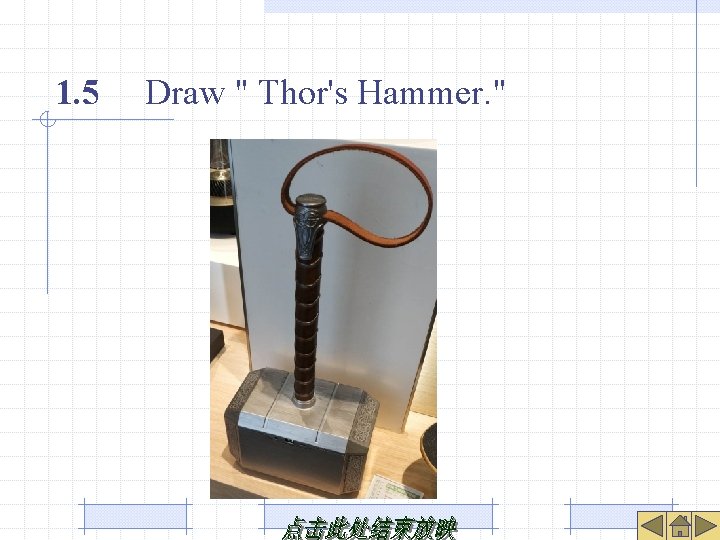
1. 5 Draw " Thor's Hammer. "
How To Draw Thor's Hammer
Source: https://slidetodoc.com/chapter-1-draw-thors-hammer-1-1-overview/
Posted by: garciadionly1958.blogspot.com
0 Response to "How To Draw Thor's Hammer"
Post a Comment